


A few years ago, AI in the workplace was still something for early adopters. Now, your colleague writes their emails with ChatGPT, your competitor creates campaigns with Gemini, and your client summarizes reports with Copilot. AI is increasingly less of an advantage in itself. It is becoming part of the standard equipment.
And that is precisely the challenge. If everyone uses similar tools, with similar prompts and without their own context, the answers quickly start to look alike. The same ideas, the same texts, the same strategies. The question is therefore no longer just whether you use AI, but how you stand out with it.
AI usage in numbers
Gallup has been tracking AI usage among US employees since 2023. In the second quarter of 2026, it looked like this:
52% used AI at least a few times a year at work. In the second quarter of 2023, this was 21%.
30% used AI at least a few times a week. Three years earlier, this was 11%.
15% used AI daily. In 2023, this was 4%.
These figures describe US employees, not Dutch companies or the entire world. The categories overlap: daily users also fall under weekly and annual use. In Gallup's later measurement in August 2026, the shares were 53%, 32%, and 16% respectively.
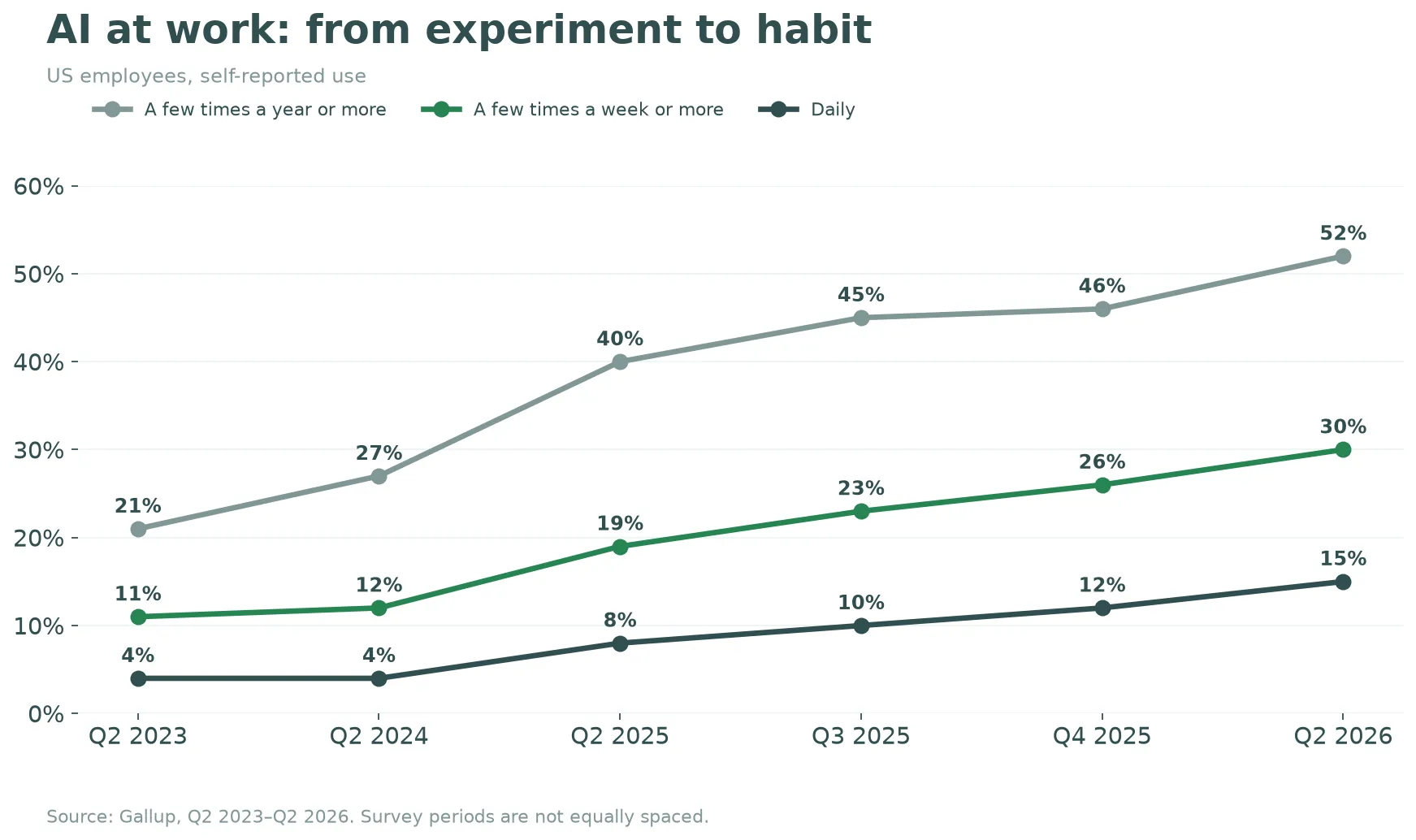
Redesigned based on Gallup. Measurement points are not evenly distributed over time, the chart compares selected quarters.
Outside of work, search behavior is also shifting. In a Pew Research Center study of US adults in February 2026, 44% reported having ever used ChatGPT. Gemini followed at 24% and Copilot at 17%. This measures chatbot usage, not search engine market share. However, it makes it clear why brands must look beyond just Google.
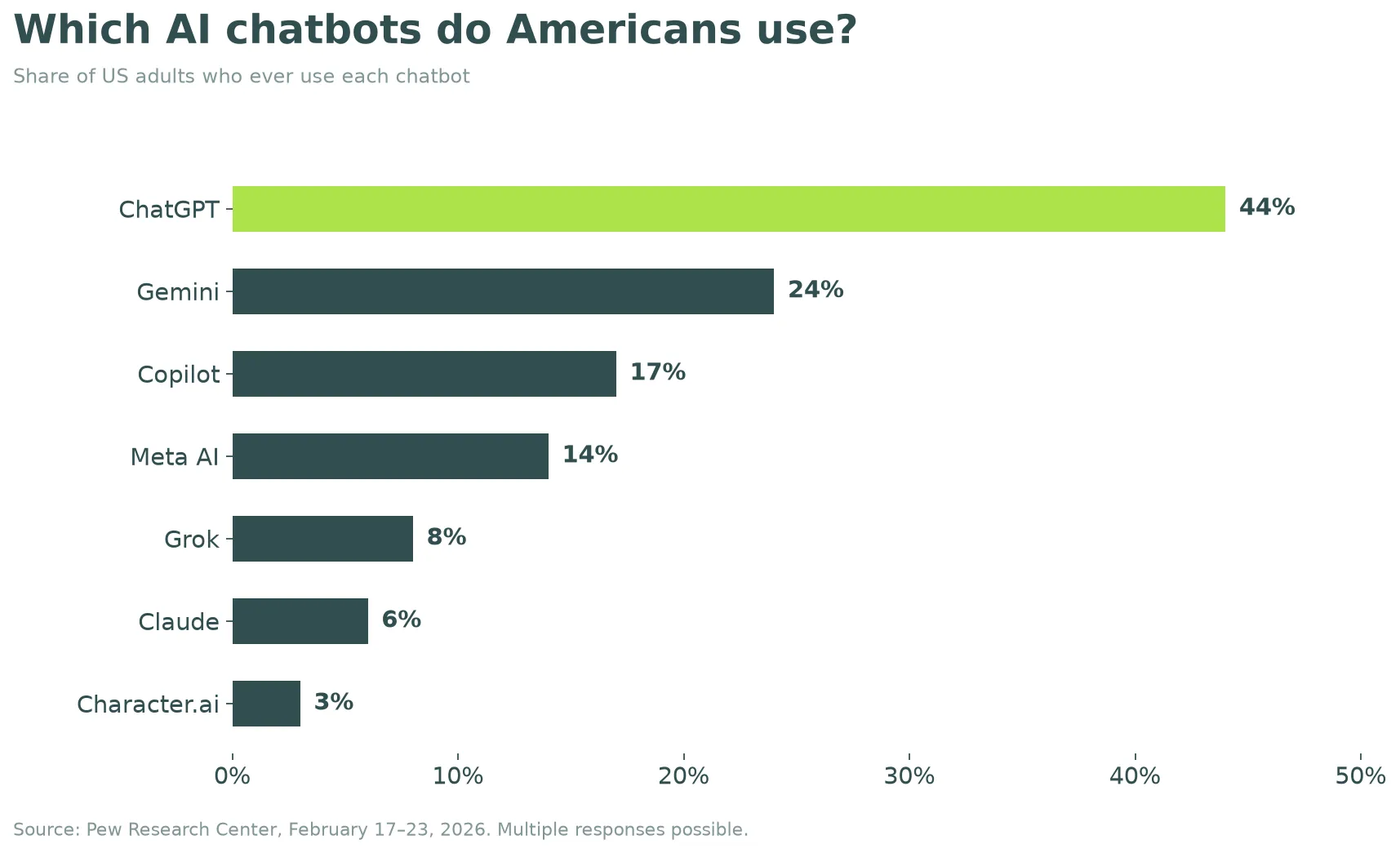
Source: Pew Research Center, study from February 17 to 23, 2026. Respondents could use multiple chatbots.
Staying ahead with Rank Monitor
As more and more people use AI, the difference lies not just in the tool, but in the questions you ask and the data you use for them. Rank Monitor helps you view SEO and AI visibility side by side and connect targeted next steps to them.
See where your brand is mentioned. Use AI Monitor to track answers to selected prompts. With AI Brand Monitor, you can investigate brand mentions and citations per platform.
Investigate the sources behind answers. See which sources reappear and where your own content is missing. A mention of a competitor is a reason for investigation, not a guarantee that the same approach will work for you.
Make insights concrete. AI Suggestions helps translate opportunities into recommendations that your team can evaluate and prioritize.
Track changes with fixed measurement points. Combine AI insights with keyword ranking, so you do not assess developments in search engines and AI answers in isolation.
This way, you not only know what is happening, but also which next step you want to test. Human judgment remains important: an AI answer can vary by prompt, platform, and measurement point.
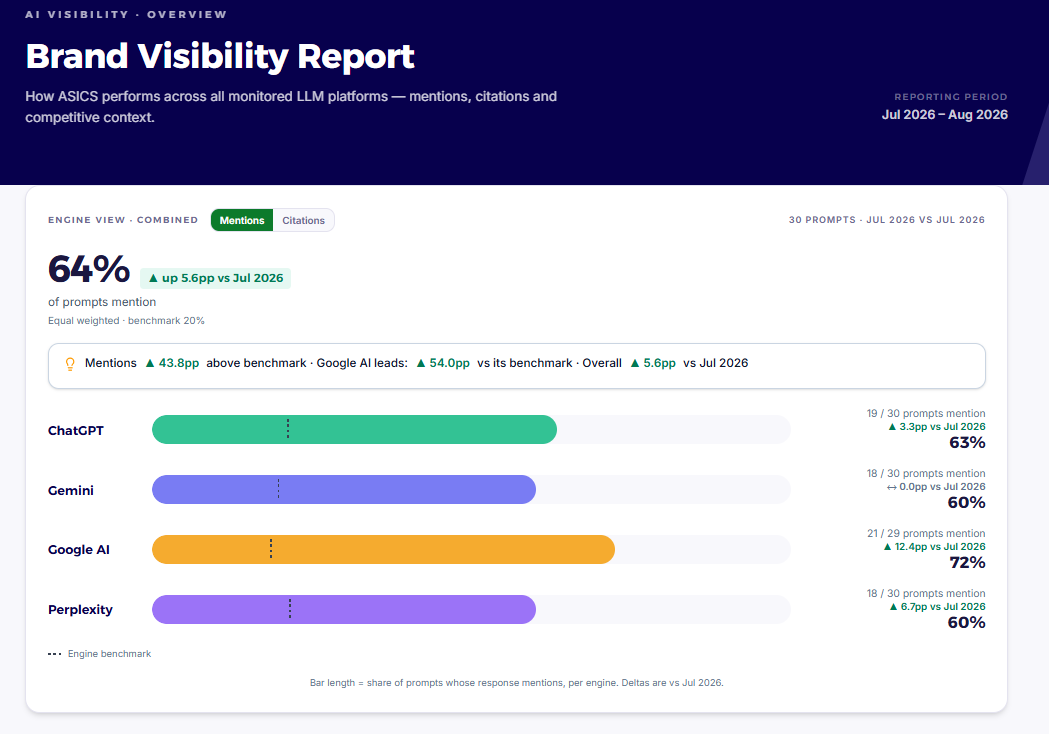
Product example from Rank Monitor. The values in this report are not research results and are not a guarantee for your brand.
The gap between frontrunners and followers
AI usage varies greatly by sector. Gallup's measurement for the fourth quarter of 2025 shows that knowledge-intensive sectors are leading the way:
Technology: 77% used AI at least a few times a year, 31% daily.
Finance and professional services: 64% and 62% used AI respectively. These sectors saw the largest growth in overall usage during that quarter.
Healthcare, government, and manufacturing: approximately 41% to 43% used AI.
Retail: 33% used AI, the lowest share in this comparison.
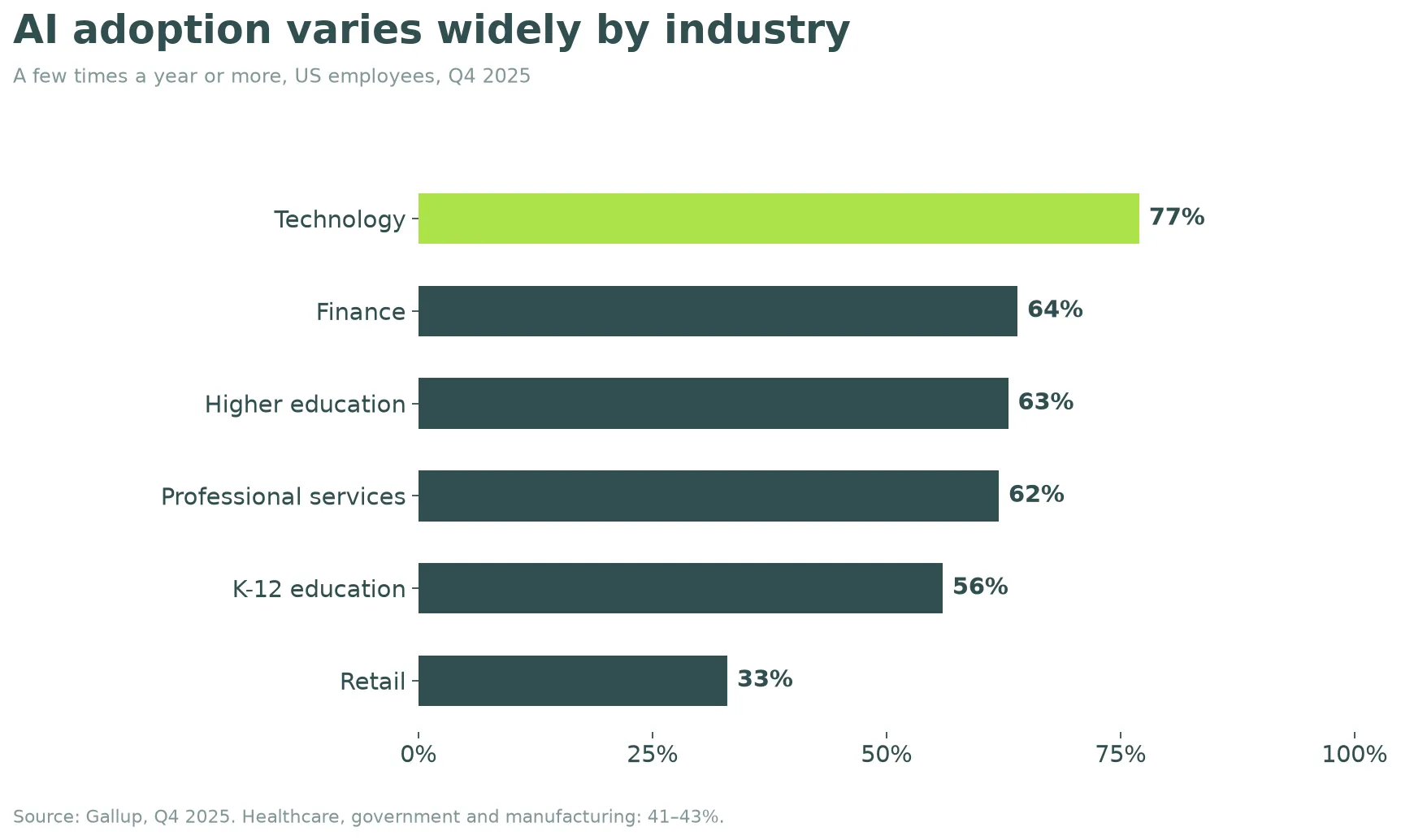
Source: Gallup, Q4 2025. These are percentages of employees, not percentages of companies. Healthcare, government, and manufacturing fall within the reported range of 41% to 43%.
The frequency highlights the difference. In the fourth quarter of 2025, the total share of AI users remained roughly the same, while daily and weekly usage continued to increase. People who were already working with AI therefore started using it more frequently. That is different from automatically achieving better business performance.
Having a tool is not yet an advantage
Availability and actual usage are two different things. According to Gallup's AI indicator for August 2026:
49% of US employees said their organization had integrated AI tools.
26% said the organization had communicated a clear plan for integrating AI.
In the May 2026 measurement, employees with a manager who actively supported AI were nearly twice as likely to use AI frequently. That is a correlation from research, not proof that support alone is the cause.
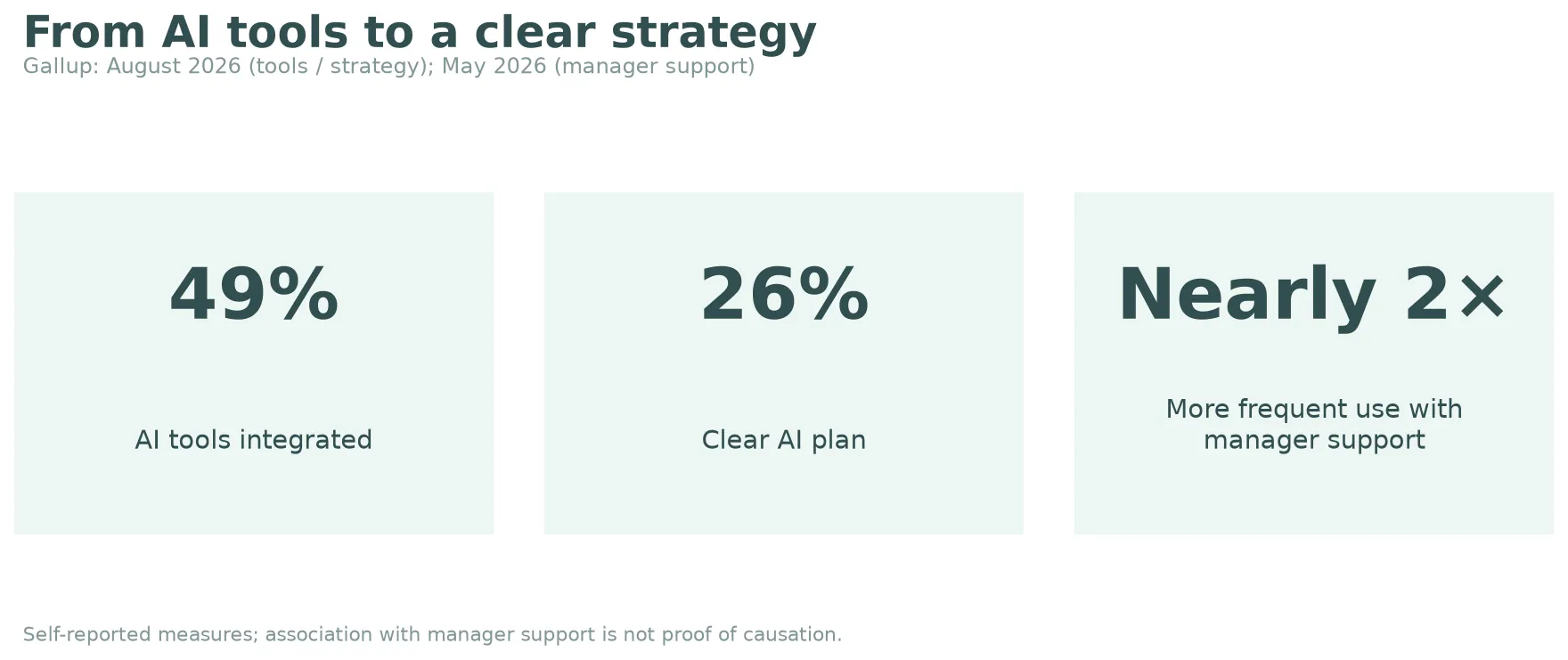
Source: Gallup AI Indicator. Tools and strategy: August 2026. Correlation with manager support: May 2026. The figures measure different aspects.
The lesson is clear. Acquiring another tool does not automatically make you distinctive. A clear approach, relevant data, and people who know what they are doing with it make the difference.
Five ways to stay distinctive
Work with your own data. Use customer questions, search behavior, and market insights to formulate better prompts. Keep privacy in mind and do not share confidential customer data without appropriate consent and agreements.
Be visible where the question is asked. Investigate which sources reappear in relevant AI answers. Create content that answers a real question and ensure that information about your brand is correct and verifiable.
Measure in a consistent way. Choose a fixed set of prompts, platforms, and measurement points. Define what you count as a mention or citation. Do not simply compare figures from studies with different definitions.
Add human expertise. AI can create a first draft. Your experience, examples, editing, and content review turn it into a usable story.
Look beyond your competitor. Use a competitor analysis as a starting point, not as a copy-paste plan. Search for unanswered questions and opportunities that fit your own expertise.
Example: the same question, a different starting point
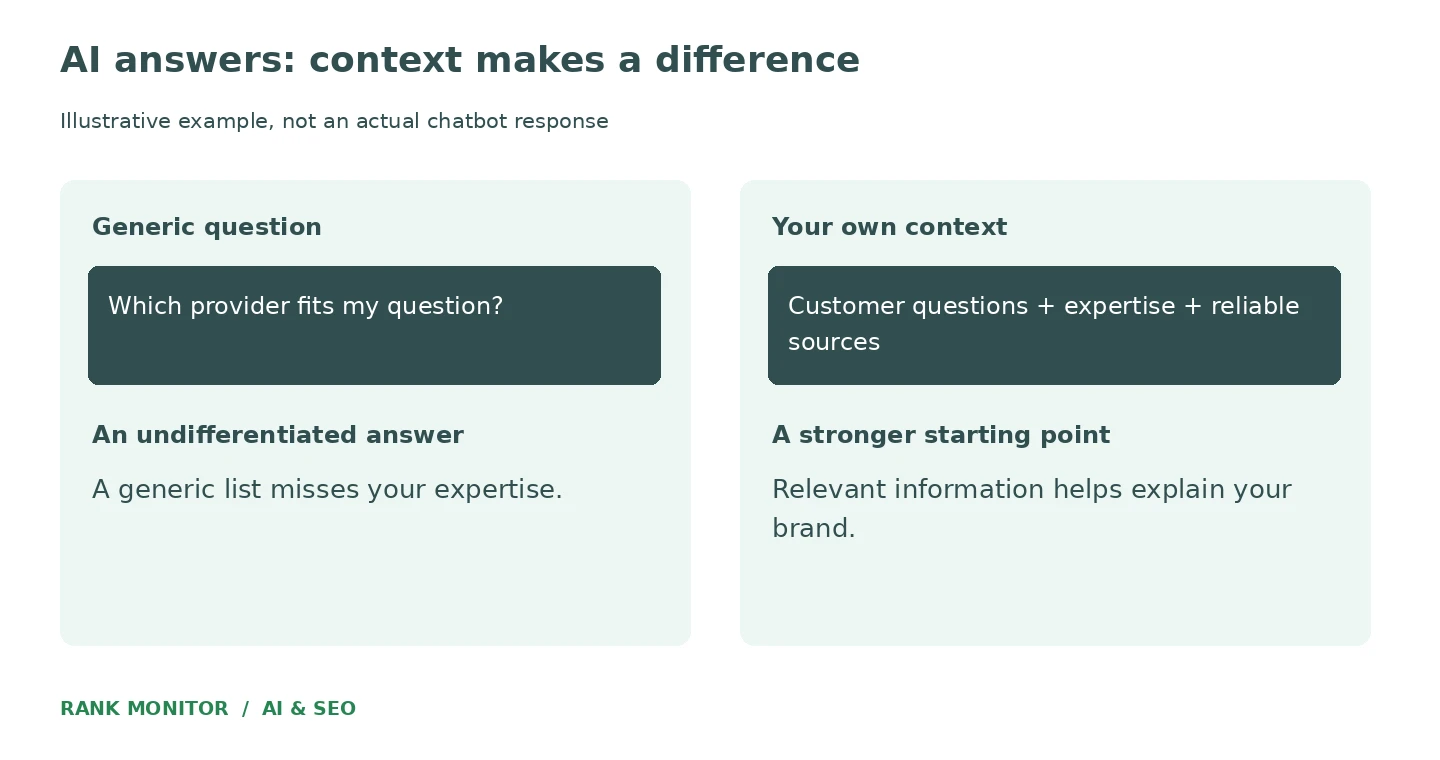
Generic prompt: “Write an article about our industry.”
Targeted prompt: “Use our ten most frequently asked customer questions and our team’s expertise to clearly explain one common problem. Mention limitations and add one of our own practical examples.”
This is an illustrative example, not an actual ChatGPT outcome. More context can make an answer more relevant, but does not guarantee a mention or a higher position. The benefit lies in the quality of your input and the control over your output.
Usage is not yet impact
In May 2026, 65% of employees in organizations that had introduced AI said that AI had a positive effect on their productivity and efficiency. Yet only 14% strongly agreed that AI had changed the way of working in their organization, according to Gallup.
AI can make existing processes faster. A distinctive approach requires more: determine which problem you want to solve, what data you need, and how you assess whether an action actually helps.
Analysis: where are you visible now and which questions remain unanswered?
Advice: which opportunity fits your target group and expertise?
Action: which improvement can your team execute and verify?
Reporting: what changed at the measurement points you chose beforehand?
Conclusion: AI is the foundation, your approach makes the difference
You do not stay distinctive by using the same tools just a little more often. You stay distinctive by connecting them to your own knowledge, relevant data, and a clear way of working.
Use data and practical experience that are not in a standard prompt.
Investigate your visibility in search engines and AI answers.
Combine AI with human expertise and factual verification.
Use Rank Monitor to track opportunities and test targeted improvements.
See what your brand is still missing
Do you want to connect SEO and AI visibility to concrete next steps? Check out AI Suggestions or request a demo. We would love to show you how Rank Monitor can fit your approach.
Sources and notes
This article uses research among US employees and adults. The results are not directly applicable to the Netherlands. The charts have been redesigned by Rank Monitor based on the sources listed below.
Gallup, Organizational AI Adoption Jumps Six Points, July 20, 2026. Usage trend Q2 2023 to Q2 2026.
Gallup, Frequent Use of AI in the Workplace Continued to Rise in Q4, January 25, 2026. Sector comparison for Q4 2025.
Gallup, Global Indicator: Artificial Intelligence, accessed November 18, 2026. Strategy and tool implementation: August 2026. Productivity and manager support: May 2026.
Pew Research Center, Americans report using ChatGPT far more than other chatbots. Study from February 17 to 23, 2026.